Thinking About GLP-1s? Here's What You Need to Know Before You Start
April 3, 2026
Thinking About GLP-1s? Here's What You Need to Know Before You Start
If you haven't tried one, you know someone who has.
GLP-1 medications — Ozempic, Wegovy, Mounjaro, Zepbound — are the most talked-about health development in a generation. And the results people are getting are real. This isn't hype. But there's a critical piece of the conversation most people aren't having, and it directly affects how much those results actually last.
Here's the full picture.
GLP-1 Medications Are Clinically Proven — Full Stop
Before anything else, let's be clear: these drugs work.
In clinical trials, people lost an average of 15–21% of their total body weight — 30 to 40 pounds for many people — without surgery. They work by mimicking a hormone that tells your brain you're full, slowing digestion and reducing appetite in a way that diet and willpower alone rarely achieve.
Beyond weight loss, GLP-1s improve blood sugar, lower blood pressure, and reduce cardiovascular disease risk. The FDA has approved them not just for obesity but for reducing the risk of heart attack and stroke.
These are serious medications producing serious, life-changing results for millions of people.
Who Is Taking GLP-1 Medications Like Ozempic and Wegovy?
The numbers are staggering. 1 in 8 American adults is currently on a GLP-1. Prescriptions for weight loss have increased 587% since 2019.¹
The group taking them most? Women between 50 and 64. According to RAND, 1 in 5 women in that age group has used a GLP-1 — the highest rate of any demographic in the country.²
That's not a coincidence. That's perimenopause — a time when weight gain can feel sudden, stubborn, and completely resistant to everything that used to work. GLP-1s offer real relief for that frustration.
But they come with a cost — and we're not just talking about price.
On the financial side, Wegovy and Mounjaro run $1,300–$1,500 per month without insurance. About half of users report the medications are difficult to afford, and cost is one of the top reasons people stop taking them.³ When people stop, the weight typically returns — and in a very specific, important way.
What Studies Show About GLP-1s and Muscle Loss
Here's the part most prescribers aren't explaining.
When you lose weight on a GLP-1, not all of it is fat. Clinical trials consistently show that **25–45% of total weight lost comes from lean mass — meaning muscle, not fat.**⁴ ⁵
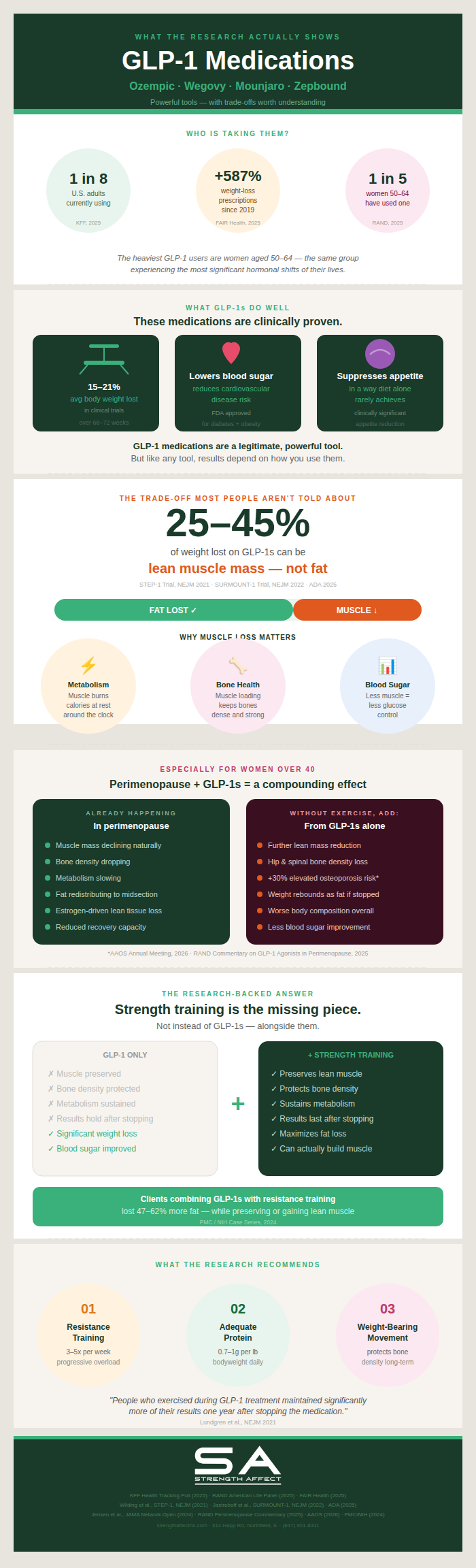
In the landmark STEP-1 semaglutide trial, the average person lost 15 kg. Nearly 7 of those kilograms — almost half — was lean tissue.
That matters because muscle isn't just about appearance. It drives your metabolism, controls blood sugar, protects your joints, and keeps you physically capable long-term. Losing it quietly while the scale drops is a trade-off worth taking seriously.
Now consider who is primarily taking these medications — women over 50. Perimenopause already causes natural muscle and bone density loss as estrogen declines. GLP-1s accelerate that process in a population already vulnerable to it.
A 2024 clinical trial found that women on GLP-1s without exercise lost bone density in the hips and spine. Women who combined the medication with regular exercise preserved their bone density and lost more fat.⁶
Newer research links long-term GLP-1 use to a 30% increased risk of osteoporosis over five years — on top of an already elevated baseline for perimenopausal women.⁷
And when people stop the drug? Weight rebounds primarily as fat — not muscle. You can end the experience lighter on the scale but with worse body composition than when you started.
GLP-1 + Strength Training: What the Research Shows
The solution is clear — and the evidence is strong.
A 2024 study followed GLP-1 users who combined their medication with resistance training three to five times per week. Their fat loss ran 47–62%. Their lean muscle mass? Preserved — and in some cases increased while on the drug.⁸
A separate study found that people who exercised consistently while on a GLP-1 maintained significantly more of their results one year after stopping the medication compared to those who relied on the drug alone.⁹
The research conclusion is consistent: GLP-1s and strength training are not alternatives. They're partners. The medication suppresses appetite. Strength training protects everything the medication can't — your muscle, your bones, your metabolism, and your long-term results.
The Logical Conclusion: Being on a GLP-1 Means You Need to Train More, Not Less
Here's the honest takeaway.
If you're on a GLP-1, the drug is doing something powerful. But your body doesn't automatically hold onto muscle while losing weight. It needs a reason to. That reason is progressive strength training.
Without it, you risk losing the muscle that makes your results meaningful — and that keeps you healthy, strong, and functional for the next 20 years.
With it, you protect your muscle, improve your bone density, sustain your metabolism, and build a body that holds onto its results whether you're on the medication or not.
Being on a GLP-1 doesn't mean you don't need to work out. It means working out matters more than it ever has.
If you're on the North Shore — in Northfield, Winnetka, Glencoe, Glenview, or Wilmette — and you're on a GLP-1 or thinking about starting one, we'd love to talk. At Strength Affect, we build programs around where your body actually is right now — and what it needs to get where you want to go.
References
- KFF Health Tracking Poll, 2025
- RAND American Life Panel Survey, 2025
- FAIR Health, 2025
- Wilding JPH et al. STEP-1 Trial. NEJM, 2021
- Jastreboff AM et al. SURMOUNT-1 Trial. NEJM, 2022
- Jensen SBK et al. JAMA Network Open, 2024
- AAOS Annual Meeting, 2026
- Funderburk LK et al. PMC/NIH Case Series, 2024
- Lundgren JR et al. NEJM, 2021


