Not all Strength is created equal - The importance of end range strength

November 30, 2025

Most people think being strong means lifting heavy weights. Double-bodyweight deadlifts, big squats, heavy bench pressing — those numbers look impressive, but they don’t tell the full story.

Real strength isn’t just what you can move in the middle of the rep.
Real strength is what you can control at the edges.

Those edge positions — the deepest part of a squat, the end of a reach, the final few degrees of rotation — are the same places where most people get hurt and the same places traditional training ignores.

If you’ve ever felt strong in the gym but fragile in real life, this is why.

At Strength Affect, we work with post-rehab clients, active adults, and people dealing with chronic pain who’ve been told they’re “strong,” yet still feel tight, achy, or limited. The truth is simple:

If you’re only strong in your mid-range, you’re not actually strong — you’re just good at the part that’s easiest.

Let’s unpack this in a way that’s easy to understand and actually useful for your training.

The Illusion of Strength: Why Most People Think They’re Stronger Than They Are

Traditional lifting teaches you to move weight through the range where you already have leverage — the middle.

That’s where the muscles produce the most force.
That’s where you feel confident.
That’s where you can stack plates.

But here’s the problem: your body doesn’t care how strong you are in the middle if it collapses at the extremes.

Two real client examples show this perfectly:

  • A female client who could deadlift twice her bodyweight… but couldn’t touch her toes without tightness and pain.
    (Strong mid-range pull, zero end-range control.)
  • A male client who could bench press 300 lbs… but couldn’t externally rotate a 5-lb dumbbell without compensating.
    (Big chest strength, no shoulder capacity.)

Both looked strong on paper.
Both were missing foundational pieces that actually keep the body resilient.

They didn’t need more weight.
They needed more capacity — the ability to control load in the ranges where they were weak.

What End-Range Strength Actually Is

End range simply means the furthest point your joint can move before it stops naturally — the bottom of the squat, the deepest part of a hinge, the final degrees of reach or rotation.

At these angles:

  • Your muscles are stretched
  • Your leverage is poor
  • Your nervous system is cautious
  • Your force output drops sharply

This isn’t a flaw. It’s how the human body works.

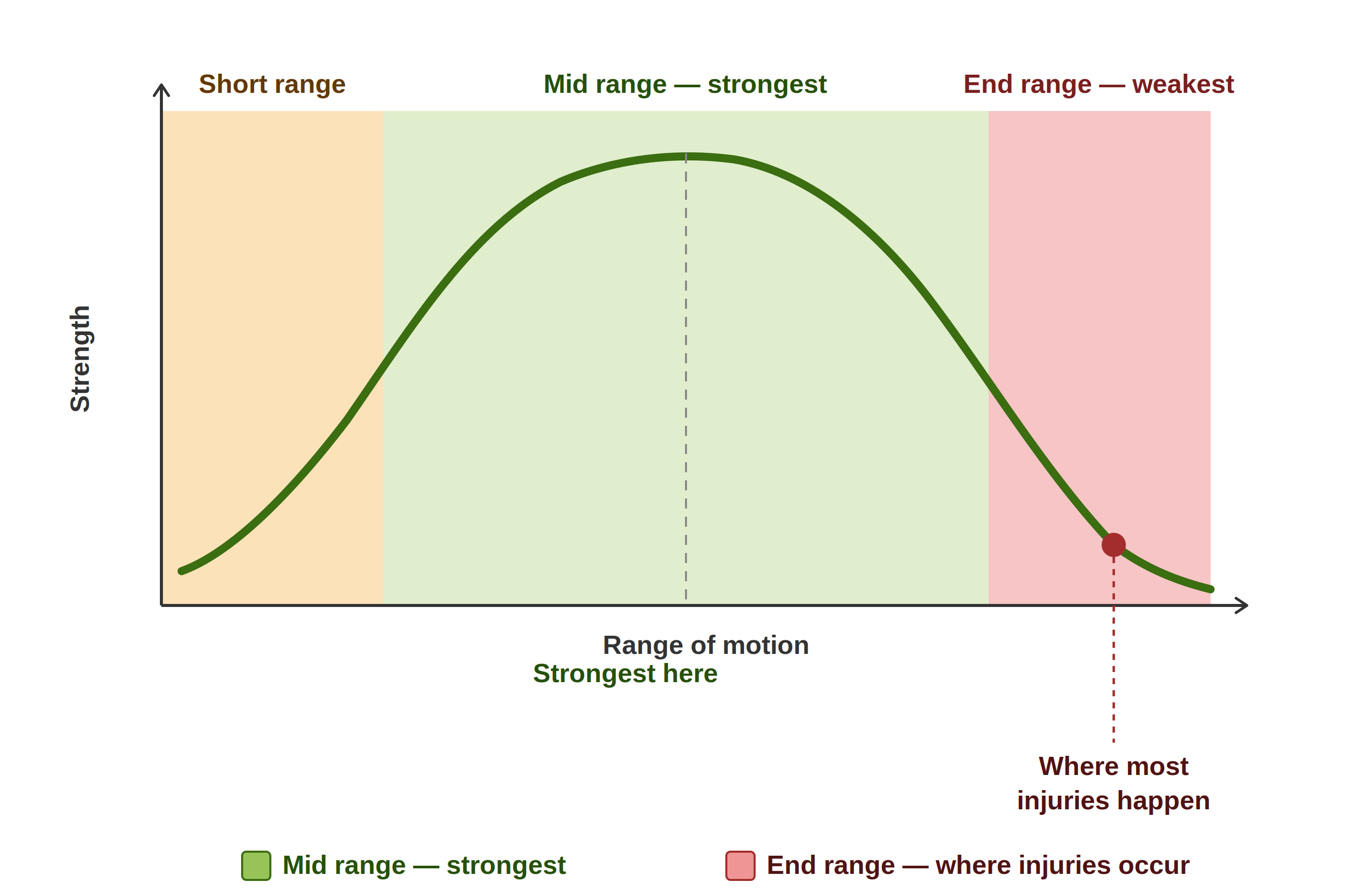
Muscles are angle-specific — meaning your strength at one joint angle doesn’t automatically transfer to other angles. You can be strong at 60° and weak at 30° or 90°.

Most daily life and most injuries happen at the angles you never train.

When you improve your force in those end ranges, your whole system becomes stronger. Many people see their “big lifts” go up without touching the barbell simply because they expanded the weak zones.

Why End-Range Strength Drives Performance

Improving end-range strength expands the entire length-tension curve (the relationship between muscle length and force production).

  • You produce the most force in the middle of a movement
  • You produce the least at the ends
  • Training the ends raises your force ceiling overall

End-range training builds:

• More total force
• Better joint mechanics
• Higher tendon capacity
• Cleaner movement patterns
• More efficient power production

Athletes love this because every sport — golf, tennis, running, lifting — asks your body to generate force in positions that aren’t perfect. Mid-range-only strength leaves huge performance gaps.

Expanding the edges elevates the whole curve.

Why Most Injuries Happen at End Range

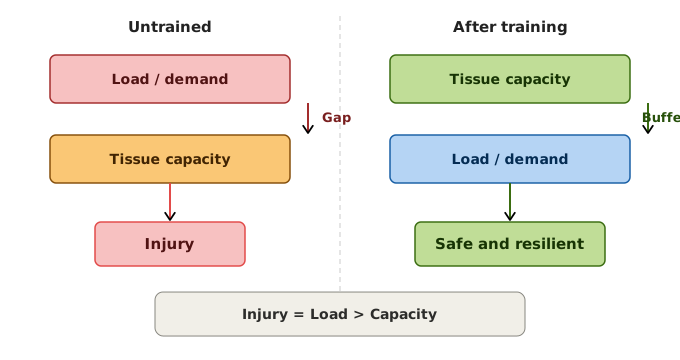
Most injuries follow one equation:

Injury = Load > Capacity

When the force placed on the body exceeds what that joint or tissue can handle, something gives.

And this happens most often at end range because those positions have the lowest capacity.

  • Rotating your spine while picking something up
  • Getting pulled slightly off-balance
  • Reaching overhead quickly
  • Twisting awkwardly while running or playing with kids

These aren’t “bad movements.”
They’re movements the body wasn’t prepared for.

Once capacity is built, these same positions become safe, strong, and controlled.

Insert your graphic: Load vs. Capacity
(Visually showing how increasing capacity reduces injury risk.)

Mobility vs. Flexibility: One Clear Explanation

People use these terms interchangeably, but they’re not the same:

  • Flexibility = how far a joint can passively move
  • Mobility = how much of that range you can control with strength

You don’t need to be bendy.
You need to be strong and stable at your end ranges.

Here’s the process we teach clients:

  1. Create space in the joint
    (Through targeted mobility techniques that open the available range.)
  2. Strengthen the end range
    (Isometrics, eccentrics, controlled articular rotations.)
  3. Integrate it into real movement
    (Squats, hinges, pushes, pulls, rotations — all with proper depth and control.)

Mobility is strength training — just in the positions you avoid.

How Strength Affect Builds Real Strength (Our System)

This is exactly why our system is built the way it is.

1. Assess

We find the exact angles where your capacity is limited.
We test mobility, stability, and strength at the edges — not just the middle.

2. Prescribe

Your program directly attacks the end-range weaknesses that keep you stiff, tight, or injury-prone.
You don’t get random “mobility drills.”
You get targeted strength work in the positions you need to own.

3. Track and Progress

As your end-range capacity improves, we layer it into your foundational lifts.
You move better.
You lift stronger.
You feel resilient.

This approach works especially well for:

  • Post-rehab adults
  • People with chronic stiffness or recurring injuries
  • Busy professionals who want to stay active without flare-ups
  • Active adults who want to perform at a higher level without breakdowns

If you want strength that lasts beyond the gym, this is the path.

Bringing It All Together

You can lift heavy weights and still lack the type of strength that actually protects your body. That’s why you can feel strong in the gym but fragile in real life.

Mid-range strength is easy to build.
End-range strength is where the real work happens.

When you learn to control the edges:

  • Your big lifts improve
  • Your mobility increases
  • Your joints feel better
  • Your risk of injury drops
  • Your real-world performance goes up

This is the difference between looking strong and being strong.

Ready to Build Strength That Actually Lasts?

If you’re tired of feeling strong one moment and stiff or vulnerable the next…
If you’re ready to train in a way that protects your joints, improves mobility, and boosts performance…

Book your free consultation with Strength Affect.

We’ll show you where your real strength is — and where it needs to go next.